Used by administrative clients to view, update, and receive observer updates from the IceGrid registry. More...
defined in <IceGrid/Admin.ice>
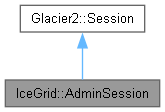
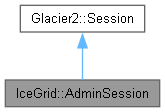
interface AdminSession extends Glacier2::Session { ... }
Operations | |
| void | finishUpdate () throws AccessDeniedException |
| Finish updating the registry and release the exclusive lock. | |
| idempotent Admin * | getAdmin () |
| Get the admin interface. | |
| idempotent Object * | getAdminCallbackTemplate () |
| Get a "template" proxy for admin callback objects. | |
| idempotent string | getReplicaName () |
| Get the name of the registry replica hosting this session. | |
| idempotent void | keepAlive () |
| Keep the session alive. | |
| FileIterator * | openNodeStdErr (string name, int count) throws FileNotAvailableException, NodeNotExistException, NodeUnreachableException |
| Open the given node stderr file for reading. | |
| FileIterator * | openNodeStdOut (string name, int count) throws FileNotAvailableException, NodeNotExistException, NodeUnreachableException |
| Open the given node stdout file for reading. | |
| FileIterator * | openRegistryStdErr (string name, int count) throws FileNotAvailableException, RegistryNotExistException, RegistryUnreachableException |
| Open the given registry stderr file for reading. | |
| FileIterator * | openRegistryStdOut (string name, int count) throws FileNotAvailableException, RegistryNotExistException, RegistryUnreachableException |
| Open the given registry stdout file for reading. | |
| FileIterator * | openServerLog (string id, string path, int count) throws FileNotAvailableException, ServerNotExistException, NodeUnreachableException, DeploymentException |
| Open the given server log file for reading. | |
| FileIterator * | openServerStdErr (string id, int count) throws FileNotAvailableException, ServerNotExistException, NodeUnreachableException, DeploymentException |
| Open the given server stderr file for reading. | |
| FileIterator * | openServerStdOut (string id, int count) throws FileNotAvailableException, ServerNotExistException, NodeUnreachableException, DeploymentException |
| Open the given server stdout file for reading. | |
| idempotent void | setObservers (RegistryObserver *registryObs, NodeObserver *nodeObs, ApplicationObserver *appObs, AdapterObserver *adptObs, ObjectObserver *objObs) throws ObserverAlreadyRegisteredException |
| Set the observer proxies that receive notifications when the state of the registry or nodes changes. | |
| idempotent void | setObserversByIdentity (Ice::Identity registryObs, Ice::Identity nodeObs, Ice::Identity appObs, Ice::Identity adptObs, Ice::Identity objObs) throws ObserverAlreadyRegisteredException |
| Set the observer identities that receive notifications the state of the registry or nodes changes. | |
| int | startUpdate () throws AccessDeniedException |
| Acquires an exclusive lock to start updating the registry applications. | |
| Operations inherited from Glacier2::Session | |
| void | destroy () |
| Destroy the session. | |
Detailed Description
Used by administrative clients to view, update, and receive observer updates from the IceGrid registry.
Admin sessions are created either via the Registry object or via the registry admin SessionManager object.
- See also
- Registry
Operation Documentation
◆ finishUpdate()
| void finishUpdate | ( | ) | throws AccessDeniedException |
Finish updating the registry and release the exclusive lock.
- Exceptions
-
AccessDeniedException Raised if the session doesn't hold the exclusive lock.
◆ getAdmin()
| idempotent Admin * getAdmin | ( | ) |
Get the admin interface.
The admin object returned by this operation can only be accessed by the session.
- Returns
- The admin interface proxy.
◆ getAdminCallbackTemplate()
| idempotent Object * getAdminCallbackTemplate | ( | ) |
Get a "template" proxy for admin callback objects.
An Admin client uses this proxy to set the category of its callback objects, and the published endpoints of the object adapter hosting the admin callback objects.
◆ getReplicaName()
| idempotent string getReplicaName | ( | ) |
Get the name of the registry replica hosting this session.
- Returns
- The replica name of the registry.
◆ keepAlive()
| idempotent void keepAlive | ( | ) |
Keep the session alive.
Clients should call this operation regularly to prevent the server from reaping the session.
- See also
- Registry::getSessionTimeout
◆ openNodeStdErr()
| FileIterator * openNodeStdErr | ( | string | name, |
| int | count ) throws FileNotAvailableException, NodeNotExistException, NodeUnreachableException |
Open the given node stderr file for reading.
The file can be read with the returned file iterator.
- Parameters
-
name The node name. count Specifies where to start reading the file. If negative, the file is read from the begining. If 0 or positive, the file is read from the last countlines.
- Returns
- An iterator to read the file.
- Exceptions
-
FileNotAvailableException Raised if the file can't be read. NodeNotExistException Raised if the node doesn't exist. NodeUnreachableException Raised if the node could not be reached.
◆ openNodeStdOut()
| FileIterator * openNodeStdOut | ( | string | name, |
| int | count ) throws FileNotAvailableException, NodeNotExistException, NodeUnreachableException |
Open the given node stdout file for reading.
The file can be read with the returned file iterator.
- Parameters
-
name The node name. count Specifies where to start reading the file. If negative, the file is read from the begining. If 0 or positive, the file is read from the last countlines.
- Returns
- An iterator to read the file.
- Exceptions
-
FileNotAvailableException Raised if the file can't be read. NodeNotExistException Raised if the node doesn't exist. NodeUnreachableException Raised if the node could not be reached.
◆ openRegistryStdErr()
| FileIterator * openRegistryStdErr | ( | string | name, |
| int | count ) throws FileNotAvailableException, RegistryNotExistException, RegistryUnreachableException |
Open the given registry stderr file for reading.
The file can be read with the returned file iterator.
- Parameters
-
name The registry name. count Specifies where to start reading the file. If negative, the file is read from the begining. If 0 or positive, the file is read from the last countlines.
- Returns
- An iterator to read the file.
- Exceptions
-
FileNotAvailableException Raised if the file can't be read. RegistryNotExistException Raised if the registry doesn't exist. RegistryUnreachableException Raised if the registry could not be reached.
◆ openRegistryStdOut()
| FileIterator * openRegistryStdOut | ( | string | name, |
| int | count ) throws FileNotAvailableException, RegistryNotExistException, RegistryUnreachableException |
Open the given registry stdout file for reading.
The file can be read with the returned file iterator.
- Parameters
-
name The registry name. count Specifies where to start reading the file. If negative, the file is read from the begining. If 0 or positive, the file is read from the last countlines.
- Returns
- An iterator to read the file.
- Exceptions
-
FileNotAvailableException Raised if the file can't be read. RegistryNotExistException Raised if the registry doesn't exist. RegistryUnreachableException Raised if the registry could not be reached.
◆ openServerLog()
| FileIterator * openServerLog | ( | string | id, |
| string | path, | ||
| int | count ) throws FileNotAvailableException, ServerNotExistException, NodeUnreachableException, DeploymentException |
Open the given server log file for reading.
The file can be read with the returned file iterator.
- Parameters
-
id The server id. path The path of the log file. A log file can be opened only if it's declared in the server or service deployment descriptor. count Specifies where to start reading the file. If negative, the file is read from the begining. If 0 or positive, the file is read from the last countlines.
- Returns
- An iterator to read the file.
- Exceptions
-
FileNotAvailableException Raised if the file can't be read. ServerNotExistException Raised if the server doesn't exist. NodeUnreachableException Raised if the node could not be reached. DeploymentException Raised if the server couldn't be deployed on the node.
◆ openServerStdErr()
| FileIterator * openServerStdErr | ( | string | id, |
| int | count ) throws FileNotAvailableException, ServerNotExistException, NodeUnreachableException, DeploymentException |
Open the given server stderr file for reading.
The file can be read with the returned file iterator.
- Parameters
-
id The server id. count Specifies where to start reading the file. If negative, the file is read from the begining. If 0 or positive, the file is read from the last countlines.
- Returns
- An iterator to read the file.
- Exceptions
-
FileNotAvailableException Raised if the file can't be read. ServerNotExistException Raised if the server doesn't exist. NodeUnreachableException Raised if the node could not be reached. DeploymentException Raised if the server couldn't be deployed on the node.
◆ openServerStdOut()
| FileIterator * openServerStdOut | ( | string | id, |
| int | count ) throws FileNotAvailableException, ServerNotExistException, NodeUnreachableException, DeploymentException |
Open the given server stdout file for reading.
The file can be read with the returned file iterator.
- Parameters
-
id The server id. count Specifies where to start reading the file. If negative, the file is read from the begining. If 0 or positive, the file is read from the last countlines.
- Returns
- An iterator to read the file.
- Exceptions
-
FileNotAvailableException Raised if the file can't be read. ServerNotExistException Raised if the server doesn't exist. NodeUnreachableException Raised if the node could not be reached. DeploymentException Raised if the server couldn't be deployed on the node.
◆ setObservers()
| idempotent void setObservers | ( | RegistryObserver * | registryObs, |
| NodeObserver * | nodeObs, | ||
| ApplicationObserver * | appObs, | ||
| AdapterObserver * | adptObs, | ||
| ObjectObserver * | objObs ) throws ObserverAlreadyRegisteredException |
Set the observer proxies that receive notifications when the state of the registry or nodes changes.
- Parameters
-
registryObs The registry observer. nodeObs The node observer. appObs The application observer. adptObs The adapter observer. objObs The object observer.
- Exceptions
-
ObserverAlreadyRegisteredException Raised if an observer is already registered with this registry.
◆ setObserversByIdentity()
| idempotent void setObserversByIdentity | ( | Ice::Identity | registryObs, |
| Ice::Identity | nodeObs, | ||
| Ice::Identity | appObs, | ||
| Ice::Identity | adptObs, | ||
| Ice::Identity | objObs ) throws ObserverAlreadyRegisteredException |
Set the observer identities that receive notifications the state of the registry or nodes changes.
This operation should be used by clients that are using a bidirectional connection to communicate with the session.
- Parameters
-
registryObs The registry observer identity. nodeObs The node observer identity. appObs The application observer. adptObs The adapter observer. objObs The object observer.
- Exceptions
-
ObserverAlreadyRegisteredException Raised if an observer is already registered with this registry.
◆ startUpdate()
| int startUpdate | ( | ) | throws AccessDeniedException |
Acquires an exclusive lock to start updating the registry applications.
- Returns
- The current serial.
- Exceptions
-
AccessDeniedException Raised if the exclusive lock can't be acquired. This might happen if the lock is currently acquired by another session.
The documentation for this interface was generated from the following file:
- IceGrid/Admin.ice
Generated by
 1.16.0